Custom Drift Boat, Skiff and Raft Oars Length Calculator


The Ultimate Oar Sizing Guide: How to Choose Oar Length for Rafts & Drift Boats

Choosing the perfect oar setup is notoriously difficult because standard marine math completely breaks down on moving water. A setup that feels perfectly balanced in a low-profile drift boat will leave you gasping for leverage in a high-side whitewater raft.

If your oars are hitting your knees, clicking together in the center, or slipping out of the oarlocks, your leverage is wrong.


To help you get a closer idea of what is required in your setup, we engineered a dynamic oar length calculator.

Try it out HERE.


Enter your exact oarlock-to-oarlock measurement to generate your custom blueprint instantly.

Every rowing setup relies on a fundamental principle of lever mechanics: The 1:2 Leverage Rule.

To achieve a clean, ergonomic stroke that minimizes fatigue over a 10-hour day, roughly one-third (33%) of your overall oar length must remain inboard (from the top of the handle to the center of the oarlock). The remaining two-thirds (66%) extends outboard into the water.

The standard calculation to achieve this balance is:
[(Oarlock-to-Oarlock Span in Inches) × 1.5] ÷ 12 = Base Oar Length in Feet

However, a raw mathematical formula doesn’t account for river dynamics or boat hull compositions. That is where choosing your exact discipline completely changes your manufacturing specs.


1. Technical Whitewater Rafting: Power, Flex, & Carbon Fiber

When you are dropping into technical Class IV wave trains or tracking heavy gear rafts through massive hydraulics, raw structural torque is non-negotiable.

  • The Length Factor: Heavy rubber raft tubes have a massive profile. To clear the fat sides of an inflatable and prevent your blades from getting sucked under in deep holes, you generally need an extra 6 to 12 inches of outboard leverage compared to rigid hulls.  This is not true in all factors, some rafts are set tighter and longer shafts are not needed.
  • The Material Profile: For true whitewater intensity, the modern standard is a Premium Carbon Fiber Shaft. Carbon fiber provides an exceptional strength-to-weight ratio, ensuring your shafts won’t snap when pulling off a wall, while maintaining just enough engineered flex to save your shoulders from high-impact shocks.
  • Rigging Specs: Whitewater setups demand heavy-duty counterweights in the handles to offset the heavy outboard weight, paired with molded oar stops to lock your positioning in volatile water.


2. Fly Fishing Drift Boats: Stealth, Tracking, & Douglas Fir

Anglers moving down glassy tailwaters or navigating tight rock gardens require a completely different tactical response. You aren’t fighting massive wave crests; you are matching the speed of a rising trout hatch.

  • The Length Factor: Rigid drift boats and skiffs sit low to the water line. You want a much snugger, tighter inboard profile. This allows for incredibly fast feathering and rapid directional adjustments without your handles constantly colliding in the center of the row cove.
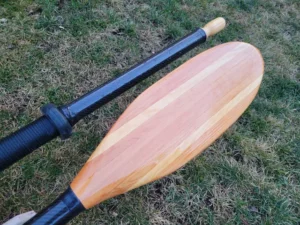
  • The Material Profile: For serious fly fishing drift configurations, nothing matches Handcrafted Laminated Douglas Fir. Douglas fir offers an organic, progressive flex memory that composite shafts cannot replicate. Wood enters the water silently, dampening all vibrations and completely eliminating the hull-ringing acoustic clatter that spooks skittish fish.
  • Rigging Specs: Drift boat oars excel when paired with traditional quiet rope wraps and balanced walnut grips. The rope wrap silences the mechanical squeak inside the oarlock, keeping your approach entirely stealthy.